Trustpilot
4.6
out of 5

General partner UG, partnership agreement, Handelsregister – we guide you through every step.
Trustpilot
4.6
out of 5
Integrations


Export and filing
As seen in



Official
Qonto
Partner
Company formation, registrations and ongoing bookkeeping in one place. Anything that requires a licence is handled by notaries and tax advisors from our partner network.
Tell us in one sentence what your UG & Co. KG will do. The AI suggests the structure and shareholdings.
We check the names for the KG and the general partner UG against the Handelsregister, the German commercial register, before you commit to them.
Check your name nowFirst comes the UG that will be liable later. We arrange the sample protocol or articles of association and the notary appointment.
Then you sign the partnership agreement for the KG, and the registration goes to the Handelsregister. We prepare your trade and tax registrations.
The KG (limited partnership) is the actual business, and its general partner (Komplementärin) is a UG (haftungsbeschränkt). The UG has unlimited liability, but only with its own assets.
The general partner UG can be set up with as little as €1 of share capital. That saves capital compared with a GmbH & Co. KG.
Limited partners (Kommanditisten) are only liable up to the amount of their contribution entered in the Handelsregister. Once it is paid in, their liability is settled.
The UG must set aside a quarter of its own annual net profit. Because it usually only receives a liability fee, this stays manageable.
The KG pays no corporate income tax. Profits are taxed directly with the partners, and losses can be offset against other income within limits.
The company name must show that no natural person has unlimited liability, for example with the suffix “UG (haftungsbeschränkt) & Co. KG”.
Agents support you from validating your idea all the way to forming your company.
Validation score
0%
+12%Starting formation
Drafting articles of association …
We handle every official registration – from trade registration to registering with the tax office.
Your company is automatically connected to all the key registers and authorities.
Your bookkeeping starts clean from day one – every receipt lands in the right account from the start.
VAT payable for June
€2,827
Output VAT €5,016 − input VAT €2,189
| Do it yourself | Traditional tax firm | firma.de | |
|---|---|---|---|
| Formation without dealing with authorities | You coordinate the notary appointment, business account and authorities yourself – around 8–12 hours of work. | Formations go through the notary and the registry court, not through the tax firm. | We coordinate the notary appointment, bank and authorities and handle every registration – you just sign. |
| Open tasks and deadlines always visible | Around 2–3 hours a month to keep track of everything yourself. | Status updates on request, usually without a portal of their own. | Visible in your account, included in every plan. |
| Dedicated bookkeeper, lawyer when needed – available around the clock | No fixed point of contact – you sort out tax and legal questions yourself. | Tax questions during office hours; for legal questions you also need a law firm. | A dedicated bookkeeper knows your company, our partner lawyers handle legal questions – and the AI agent answers around the clock. |
| Real-time bookkeeping incl. management reports and VAT returns | You do the bookkeeping, management reports and VAT returns yourself – around 4–6 hours a month. | Management reports and VAT returns only arrive after the month-end close, usually weeks later. | Every receipt is booked as soon as it arrives – management reports and VAT returns are always up to date. |
| Payroll in the same system | Hard to manage without dedicated software, and you are liable for the filings. | Around €10–20 per payslip and month. | Included from the Operations plan. |
| Annual accounts and e-balance sheet | Possible, but preparing and submitting them is then entirely up to you. | Around €1,000–2,500 a year, depending on size. | Included from the Growth plan, prepared by the partner tax firm. |
| Commercial register changes taken care of | Around 2–4 hours of preparation per change; the notary appointment remains mandatory. | Register changes go through the notary and the court, not through the tax firm. | We prepare the documents and coordinate the notary appointment. |
Times and costs are based on experience and depend on the individual case.
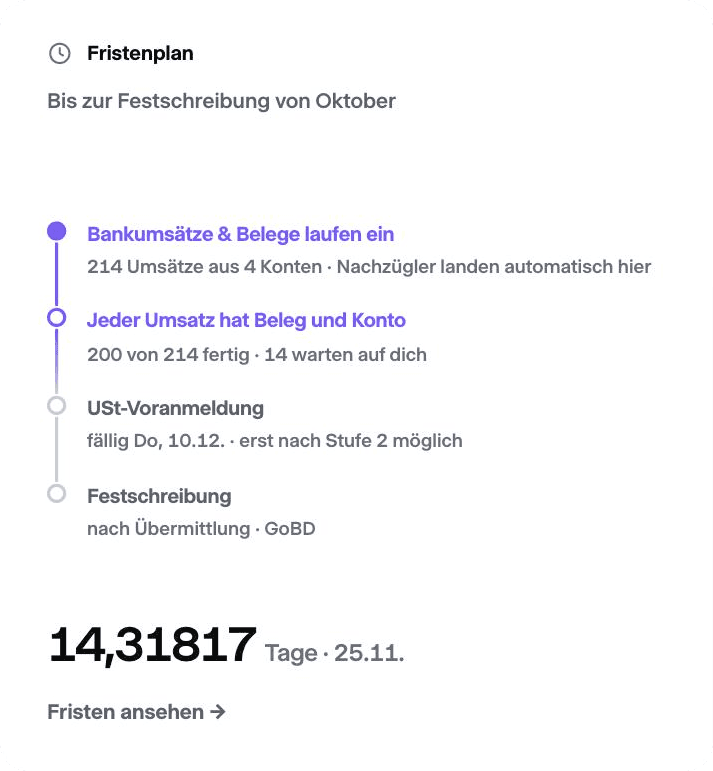
VAT every month, payroll every month, annual accounts every year. firma.de keeps track of the deadlines and always shows where you really stand – your tax firm keeps working on the same data.
Get startedAll official registrations included, three months free via the waitlist.
from€99/month
Bookkeeping for sole traders and small companies.
Join the waitlistBook a demoIncluded:
 Recommended
from€199/month
For companies that want to hand over bookkeeping and annual accounts entirely.
Join the waitlistBook a demoEverything in Start, plus:
from€399/month
For teams with staff, several accounts and their own requirements.
Join the waitlistBook a demoEverything in Growth, plus:
All prices net, plus VAT. Services that require a licence are provided by our partner firms.

€500 credit on Stripe fees – for new Stripe customers.
Worth approx. €500 / year

Three months of Workspace Business Standard free for your team.
Worth approx. €360 / year
30% off Starter and Professional in the first year.
Worth approx. €450 / year
Six months of Notion Plus with AI for your whole team.
Worth approx. €300 / year

25% off Slack Pro in the first year – for your team and tax firm.
Worth approx. €180 / year

Three months of Dropbox Business – share folders directly with your tax firm.
Worth approx. €150 / year

50,000 tokens for searches in the commercial and transparency registers.
Worth approx. €600 / year
Two months of Personio free for your first employees.
Worth approx. €360 / year
Values based on list prices; the partners' terms apply.

“Since we started the company, our admin simply runs alongside: receipts, VAT returns, deadlines. We always know where we stand – and can focus on our product.”
We'll go through setting up your UG & Co. KG with you and answer your questions before you start.
VAT returns and annual accounts go straight to the tax office via the ELSTER interface.
Bookings and receipts are ready in DATEV format – your tax firm keeps working as usual.
4.6 out of 5 on Trustpilot. Rated by founders who have actually used firma.de.
Developed in Germany, servers in the EU, GDPR-compliant. Anything that requires a licence comes from tax advisors and notaries.
The UG & Co. KG is a limited partnership (KG) whose only personally liable partner is a UG (haftungsbeschränkt) (§ 161 Abs. 1 HGB). It is formed in two steps: first the UG at the notary, then the KG. Notary and register cost €464.89 for the general partner UG with the sample protocol, whether with €1 or €1,000 share capital.
Notarise the general partner UG. Usually with the sample protocol, see sample protocol. Its object is liability and management as general partner of the KG.
Pay in the full share capital. For a UG, the entire share capital, in cash, before the notary files (§ 5a Abs. 2 GmbHG). How much makes sense is covered under capital.
Wait for the UG's registration. On registration the UG comes into existence (§ 11 Abs. 1 GmbHG) and receives the register number that goes into the KG's filing (§ 106 Abs. 2 HGB).
Sign the partnership agreement. Between the UG and the limited partners; it sets liability amounts, contributions, profit split and the UG's fee, see reserve and profit share.
File the KG. All partners sign the filing with the limited partners' liability amounts (§ 162 Abs. 1 HGB), a notary certifies it (§ 12 Abs. 1 HGB). Once it is entered, the UG & Co. KG is complete.
What the partnership agreement should contain, when it does need a notary and which mistakes before the entry become expensive is explained in detail in our guide to the GmbH & Co. KG; for the KG itself, the general partner's legal form makes no difference. Our package for both steps is under pricing.
The difference from the GmbH & Co. KG lies almost entirely with the general partner: less capital tied up before the filing and somewhat lower notary costs. With the sample protocol, the company bears up to €300 of its formation costs, at most up to its share capital; the founders pay the rest privately.
| General partner | Notary and register | Paid in before filing | Borne by the company | Paid by the founders |
|---|---|---|---|---|
| UG, 1 shareholder, €1 | €464.89 | €1 | €1 | €463.89 |
| UG, 1 shareholder, €1,000 | €464.89 | €1,000 | €300 | €164.89 |
| UG, 2 shareholders, €3,000 | €545.81 | €3,000 | €300 | €245.81 |
| GmbH, 1 shareholder, €25,000 | €590.55 | €12,500 | €300 | €290.55 |
For the KG's filing, the notary charges on the sum of the liability amounts plus €30,000 for the general partner, at least €30,000 (§ 105 Abs. 1 Nr. 5 GNotKG). This addition is the same for a UG as for a GmbH, so the UG & Co. KG saves nothing here. On top come the KG's register fee, a partnership agreement drafted by a lawyer and €19.80 a year per company for the transparency register. Check the general partner's items in our formation cost calculator.
Legally, €1 of share capital is enough (§ 5a Abs. 1 GmbHG). The real capital of a UG & Co. KG, however, sits in the KG: the limited partners pay their contributions in there, and that money runs the business. The UG only needs what it needs for itself. How much that is depends on three points:
Contributions in kind are excluded for the UG (§ 5a Abs. 2 GmbHG). That does not apply to the KG: a limited partner can contribute a vehicle, machinery or an existing sole proprietorship to the KG.
Pros
Cons
As long as its share capital is below €25,000, every UG must put a quarter of its annual net profit, reduced by any loss carried forward, into a statutory reserve (§ 5a Abs. 3 GmbHG). For the general partner UG this profit is small: it usually has no capital share in the KG and only gets its expenses reimbursed and a fee for the liability risk.
An example: if the UG is left with €2,000 of net profit after tax, €500 go into the reserve. Reaching €25,000 takes decades, so the reserve alone will hardly turn the UG into a GmbH.
To be on the safe side, give the UG a fixed liability fee in the partnership agreement and let it actually build the reserve. The amount is best agreed with a tax advisor.
The general partner UG can be formed with the sample protocol as long as it has at most three shareholders and one managing director (§ 2 Abs. 1a GmbHG). Since it has hardly any business of its own, that is usually enough. Three points differ in the KG structure from an ordinary UG:
More shareholders, several managing directors or your own voting rules need individual articles of association. Everything about the UG itself, from liability to the obligations after formation, is under forming a UG.
If no natural person in a KG is liable without limit, the name must show the limitation of liability (§ 19 Abs. 2 HGB). For the UG & Co. KG, this means the general partner's suffix appears in full in the KG's name, as “UG (haftungsbeschränkt) & Co. KG”. As with the UG itself, “haftungsbeschränkt” must not be abbreviated (§ 5a Abs. 1 GmbHG); “UG & Co. KG” alone does not show that nobody is personally liable.
A UG & Co. KG may not call itself “GmbH & Co. KG”, because that suggests share capital of at least €25,000 (§ 18 Abs. 2 HGB). Anyone trading under that name anyway risks personal liability. Whether the name is free is shown by our company name check.
If the general partner UG raises its share capital to at least €25,000, the special UG rules no longer apply, including the reserve requirement (§ 5a Abs. 5 GmbHG). It may keep its name or change it to “GmbH” by amending its articles.
The KG stays the same: limited partnership interests, liability amounts, tax number, accounts and contracts do not change. If you have the capital for the GmbH from the start, form a GmbH & Co. KG right away.
For the KG itself it makes no difference whether its general partner is a UG or a GmbH. The key rules in brief; they are set out in detail with examples in our guide to the GmbH & Co. KG:
As of 9 October 2026. Our formation cost calculator computes the general partner's costs under the GNotKG and the commercial register fee ordinance. This guide is no substitute for legal or tax advice; for your case, get advice from a lawyer or a tax advisor.
A limited partnership (Kommanditgesellschaft) whose personally liable partner is a UG (haftungsbeschränkt). It works like the GmbH & Co. KG, just with a cheaper general partner.
The UG & Co. KG needs less start-up capital. However, banks, landlords and business partners more often ask for security when the general partner has little capital. If you plan for the long term, you can later top up the UG to a GmbH.
For the general partner UG, at least €1, paid in full. More is sensible, so it can cover the formation costs. There is no minimum capital for the KG itself; you set the liability amounts of the limited partners.
The KG pays trade tax but no corporate income tax. Profits are taxed proportionately with the partners at their personal tax rate, and the general partner UG pays tax on its liability fee itself.
The general partner UG, represented by its managing director. Limited partners are excluded from management but have rights of control.
Yes. If you increase the general partner's share capital to €25,000, it can trade as a GmbH, and the UG & Co. KG becomes a GmbH & Co. KG.
First the general partner UG is formed, then the KG. This usually takes a few days to a few weeks, depending on how quickly the registry court makes the entry.

