Trustpilot
4.6
out of 5

Articles of association, notary appointment, Handelsregister – we handle the rest.
Trustpilot
4.6
out of 5
Integrations


Export and filing
As seen in



Official
Qonto
Partner
Company formation, registrations and ongoing bookkeeping in one place. Anything that requires a licence is handled by notaries and tax advisors from our partner network.
Tell us in one sentence what your holding company will do. The AI suggests the business purpose and structure.
We check your preferred name against the Handelsregister, the German commercial register, before you commit to it.
Check your name nowYour sample protocol (Musterprotokoll) or articles of association are ready, and we arrange the notary appointment.
Once the share capital is paid in, the registration goes to the Handelsregister. We prepare your trade and tax registrations.
Dividends from the subsidiary to the holding company are 95% exempt from corporate income tax if the holding owns at least 10%. The effective tax is around 1.5%.
If the holding company owns at least 15% at the start of the year, dividends also remain largely exempt from trade tax.
If the holding company sells shares in a subsidiary, these gains are also 95% tax-free, regardless of the size of the shareholding.
Each subsidiary is liable on its own. If one business goes wrong, the holding company and the other subsidiaries stay protected.
If you already have a GmbH, you transfer its shares to the holding company, often tax-neutrally through a share exchange (Anteilstausch). A seven-year lock-up period then applies.
The notarisation takes place by video call via the system of the Federal Chamber of Notaries, with no appointment in person.
Agents support you from validating your idea all the way to forming your company.
Validation score
0%
+12%Starting formation
Drafting articles of association …
We handle every official registration – from trade registration to registering with the tax office.
Your company is automatically connected to all the key registers and authorities.
Your bookkeeping starts clean from day one – every receipt lands in the right account from the start.
VAT payable for June
€2,827
Output VAT €5,016 − input VAT €2,189
| Do it yourself | Traditional tax firm | firma.de | |
|---|---|---|---|
| Formation without dealing with authorities | You coordinate the notary appointment, business account and authorities yourself – around 8–12 hours of work. | Formations go through the notary and the registry court, not through the tax firm. | We coordinate the notary appointment, bank and authorities and handle every registration – you just sign. |
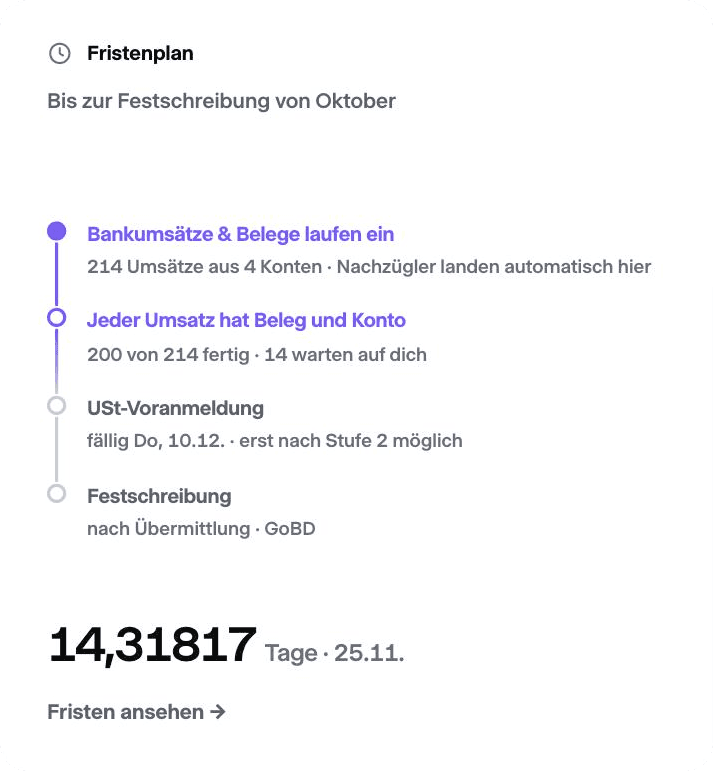
| Open tasks and deadlines always visible | Around 2–3 hours a month to keep track of everything yourself. | Status updates on request, usually without a portal of their own. | Visible in your account, included in every plan. |
| Dedicated bookkeeper, lawyer when needed – available around the clock | No fixed point of contact – you sort out tax and legal questions yourself. | Tax questions during office hours; for legal questions you also need a law firm. | A dedicated bookkeeper knows your company, our partner lawyers handle legal questions – and the AI agent answers around the clock. |
| Real-time bookkeeping incl. management reports and VAT returns | You do the bookkeeping, management reports and VAT returns yourself – around 4–6 hours a month. | Management reports and VAT returns only arrive after the month-end close, usually weeks later. | Every receipt is booked as soon as it arrives – management reports and VAT returns are always up to date. |
| Payroll in the same system | Hard to manage without dedicated software, and you are liable for the filings. | Around €10–20 per payslip and month. | Included from the Operations plan. |
| Annual accounts and e-balance sheet | Possible, but preparing and submitting them is then entirely up to you. | Around €1,000–2,500 a year, depending on size. | Included from the Growth plan, prepared by the partner tax firm. |
| Commercial register changes taken care of | Around 2–4 hours of preparation per change; the notary appointment remains mandatory. | Register changes go through the notary and the court, not through the tax firm. | We prepare the documents and coordinate the notary appointment. |
Times and costs are based on experience and depend on the individual case.
VAT every month, payroll every month, annual accounts every year. firma.de keeps track of the deadlines and always shows where you really stand – your tax firm keeps working on the same data.
Get startedAll official registrations included, three months free via the waitlist.
from€99/month
Bookkeeping for sole traders and small companies.
Join the waitlistBook a demoIncluded:
 Recommended
from€199/month
For companies that want to hand over bookkeeping and annual accounts entirely.
Join the waitlistBook a demoEverything in Start, plus:
from€399/month
For teams with staff, several accounts and their own requirements.
Join the waitlistBook a demoEverything in Growth, plus:
All prices net, plus VAT. Services that require a licence are provided by our partner firms.

€500 credit on Stripe fees – for new Stripe customers.
Worth approx. €500 / year

Three months of Workspace Business Standard free for your team.
Worth approx. €360 / year
30% off Starter and Professional in the first year.
Worth approx. €450 / year
Six months of Notion Plus with AI for your whole team.
Worth approx. €300 / year

25% off Slack Pro in the first year – for your team and tax firm.
Worth approx. €180 / year

Three months of Dropbox Business – share folders directly with your tax firm.
Worth approx. €150 / year

50,000 tokens for searches in the commercial and transparency registers.
Worth approx. €600 / year
Two months of Personio free for your first employees.
Worth approx. €360 / year
Values based on list prices; the partners' terms apply.

“Since we started the company, our admin simply runs alongside: receipts, VAT returns, deadlines. We always know where we stand – and can focus on our product.”
We'll go through setting up your holding company with you and answer your questions before you start.
VAT returns and annual accounts go straight to the tax office via the ELSTER interface.
Bookings and receipts are ready in DATEV format – your tax firm keeps working as usual.
4.6 out of 5 on Trustpilot. Rated by founders who have actually used firma.de.
Developed in Germany, servers in the EU, GDPR-compliant. Anything that requires a licence comes from tax advisors and notaries.
You form a holding company at the notary like any GmbH; its purpose is to hold shares in other companies. What matters is whether you build a new shareholding or bring in an existing GmbH. Notary and commercial register cost €590.55 for a holding GmbH with the sample protocol (Musterprotokoll) and one founder.
Plan the structure. Who holds the holding, and which companies sit below it? If you found together, each partner often holds their stake in the joint GmbH through a holding of their own, see structure.
New company or contribution. For a new business you first form the holding with cash. An existing GmbH comes in through a share-for-share exchange, see contribution.
Choose the legal form. Usually a GmbH. A UG works from €1, but only with cash, see UG as a holding.
Word the object of the company. Typically “acquiring, holding and managing shareholdings and managing its own assets”. If the holding takes on tasks for its subsidiaries, such as managing them, add that too.
Notarisation. Sample protocol or articles of association; a cash formation also works by video call (§ 2 Abs. 3 GmbHG). A formation with GmbH shares as a contribution in kind needs articles.
Pay in the share capital. For a cash formation at least €12,500 into the holding's account before the notary files the registration (§ 7 Abs. 2 GmbHG). You can compare providers under business accounts.
Commercial register. The notary files the holding electronically; it comes into existence when it is entered (§ 11 Abs. 1 GmbHG). The responsible court is listed in our commercial register directory.
Transfer the shareholding, inform the authorities. The holding forms the subsidiary or takes over your shares; the tax office and the transparency register follow, see obligations.
With firma.de the notarisation is usually possible within 48 hours; how fast the entry follows depends on the registry court. You find our package under pricing.
In the usual structure you privately hold the shares in the holding GmbH, and the holding holds the shares in your operating GmbH. The operating GmbH pays tax on its profit as before. When it distributes, the money goes to the holding instead of to you, and there it stays almost tax-free:
| Recipient | Tax | Left to reinvest |
|---|---|---|
| You privately, without a holding | €26,375 | €73,625 |
| Holding with at least 15% at the start of the year | €1,491 | €98,509 |
| Holding with 10% to under 15% at the start of the year | €14,791 | €85,209 |
In the example the holding pays 1.49% tax, you privately pay the 25% flat-rate tax plus solidarity surcharge (§ 32d EStG). The holding only defers this tax, though: when you later take the money out of the holding privately, the flat-rate tax is due then. A holding pays off when profits stay in the business and are reinvested, for example in further companies, securities or a real estate GmbH.
If you need the profits privately right away, a holding gains you nothing and adds the costs of a formation, bookkeeping and a second set of annual accounts.
If you plan a new business, the route is simple: first you form the holding, then the holding forms the operating GmbH as its shareholder. There is no valuation and no lock-up period. It gets harder when the GmbH already exists and makes profits.
If you contribute your GmbH shares in exchange for new shares in the holding, the holding in principle books them at their fair market value; you then pay tax on the hidden reserves at once, as if you had sold. On application the book value applies instead, or your acquisition costs for shares held privately (§ 21 Abs. 1, 2 UmwStG), if:
The holding files the application with its tax office; without it, the fair market value applies. Selling your shares to the holding is not a share exchange; the gain would be taxable at once.
Either way the notary records the assignment of the shares (§ 15 Abs. 3 GmbHG).
If the holding sells the contributed shares within seven years, the contribution is taxed retroactively in your hands (Einbringungsgewinn II); the amount falls by one seventh for every full year since the contribution (§ 22 Abs. 2 UmwStG). For seven years you prove to the tax office by 31 May each year who owns the shares; without that proof they count as sold (§ 22 Abs. 3 UmwStG).
If the GmbH owns real estate, the transfer can also trigger real estate transfer tax. Have the contribution calculated by a tax advisor beforehand.
Dividends from a corporation are disregarded when the holding's income is determined (§ 8b Abs. 1 KStG). Of them, 5% count as business expenses it may not deduct (§ 8b Abs. 5 KStG); in effect 95% are tax-free and 5% are taxed normally.
As a GmbH, the holding is always subject to trade tax (§ 2 Abs. 2 GewStG). It deducts dividends from its trade income if the stake was at least 15% at the start of the assessment period (§ 9 Nr. 2a GewStG). The 5% non-deductible expenses remain subject to trade tax too; that is where the roughly 1.5% in the example above comes from.
If the stake is lower, the dividend is added back to trade income (§ 8 Nr. 5 GewStG); in the example the holding's tax rises from €1,491 to €14,791. Unlike for corporate income tax, an acquisition during the year does not count as made at the start of the year here. If your GmbH only comes into the holding during the year, it therefore often distributes only in the following year.
Instead of paying dividends, the subsidiary can transfer its entire profit to the holding under a profit transfer agreement. Its income is then attributed directly to the holding (fiscal unity, Organschaft, § 14 KStG). Conditions: the holding has held the majority of the voting rights since the start of the subsidiary's financial year (Abs. 1 Nr. 1), and the agreement runs for at least five years and is actually carried out (Abs. 1 Nr. 3). With a GmbH as subsidiary it must provide for loss absorption under § 302 AktG (§ 17 KStG). For trade tax the subsidiary then counts as a permanent establishment of the holding (§ 2 Abs. 2 Satz 2 GewStG).
Pros
Cons
For a holding above a single profitable GmbH, the participation exemption is usually enough. A fiscal unity pays off mainly when profits and losses of several companies come together.
A UG (haftungsbeschränkt) can be a holding too; as a corporation it gets the same participation exemption. With the sample protocol and €1,000 share capital it costs €464.89 instead of €590.55 for the GmbH. Two limits are worth knowing:
From the reserve the UG can later raise its capital to €25,000 and is then legally a GmbH. More in our guide to forming a UG.
Notary and commercial register fees depend on the share capital, the number of founders and the sample protocol or articles, not on the purpose. A holding GmbH costs as much as any other GmbH:
| Formation | Notary (gross) | Commercial register | Total | Borne by the holding |
|---|---|---|---|---|
| Holding GmbH, 1 founder, sample protocol, €25,000 | €290.55 | €300 | €590.55 | €300 |
| Holding GmbH, 1 founder, articles, €25,000 | €807.49 | €300 | €1,107.49 | €1,107.49 |
| Holding UG, 1 founder, sample protocol, €1,000 | €164.89 | €300 | €464.89 | €300 |
For a formation in kind with your GmbH shares, the commercial register charges €480 instead of €300. On top, the notary records the assignment of the shares based on their value, and valuation and tax advice come in; these items depend on the value of your GmbH and are not in the table.
Ongoing costs are €19.80 a year for the transparency register, the basic IHK fee of €60–360, and bookkeeping and annual accounts. Every item is in our formation cost calculator (in German).
After the entry, the holding has the same obligations as any GmbH, even if it only holds shares:
As of 9 October 2026. Our formation cost calculator (in German) computes the fees under the GNotKG, the commercial register fee ordinance and the GmbHG, with every item and assumption. The tax examples use the statutory rates and an example municipal multiplier. This guide is no substitute for legal or tax advice; for your structure, get advice from a tax advisor or a lawyer.
A holding company is usually a GmbH or UG that holds shares in other companies. If it owns at least 10% of a subsidiary, the subsidiary's dividends are 95% exempt from corporate income tax. From a 15% shareholding at the start of the year, this also applies to trade tax. Gains from selling shares are also 95% tax-free (§ 8b KStG). This lets you reinvest profits almost tax-free.
Above all when your GmbH makes profits that you don't need privately but want to reinvest, for example in new companies, property or securities. Tax advice will tell you whether the extra effort for bookkeeping and annual accounts pays off.
If the holding company owns at least 10%, 95% of the dividend is exempt from corporate income tax, and the remaining 5% is taxed normally. If it owns at least 15% at the start of the year, this also applies to trade tax. The effective tax is then around 1.5%. Flat-rate withholding tax (Abgeltungsteuer) is only due when you take money out of the holding company privately.
Yes. You set up the holding company and transfer your shares to it, often tax-neutrally through a share exchange under § 21 UmwStG. If the subsidiary is sold within seven years, tax may be charged retroactively.
Both are possible. A UG is cheaper to set up but has to build up reserves. For a holding company with several shareholdings, the GmbH is usually the more solid choice.
No. A holding company can hold any number of subsidiaries. With several shareholders, each often sets up their own holding company, which then holds a stake in the joint GmbH.
As a GmbH, €25,000, of which at least €12,500 must be paid in before registration for a cash formation. As a UG, €1 is enough.
Yes. The articles of association or sample protocol (Musterprotokoll) are notarised, and the application to the Handelsregister (the German commercial register) is certified by a notary. This can now also be done online by video.

